Aggregated Prediction Sentiment vs Direct Institutional Formulations
 Available in US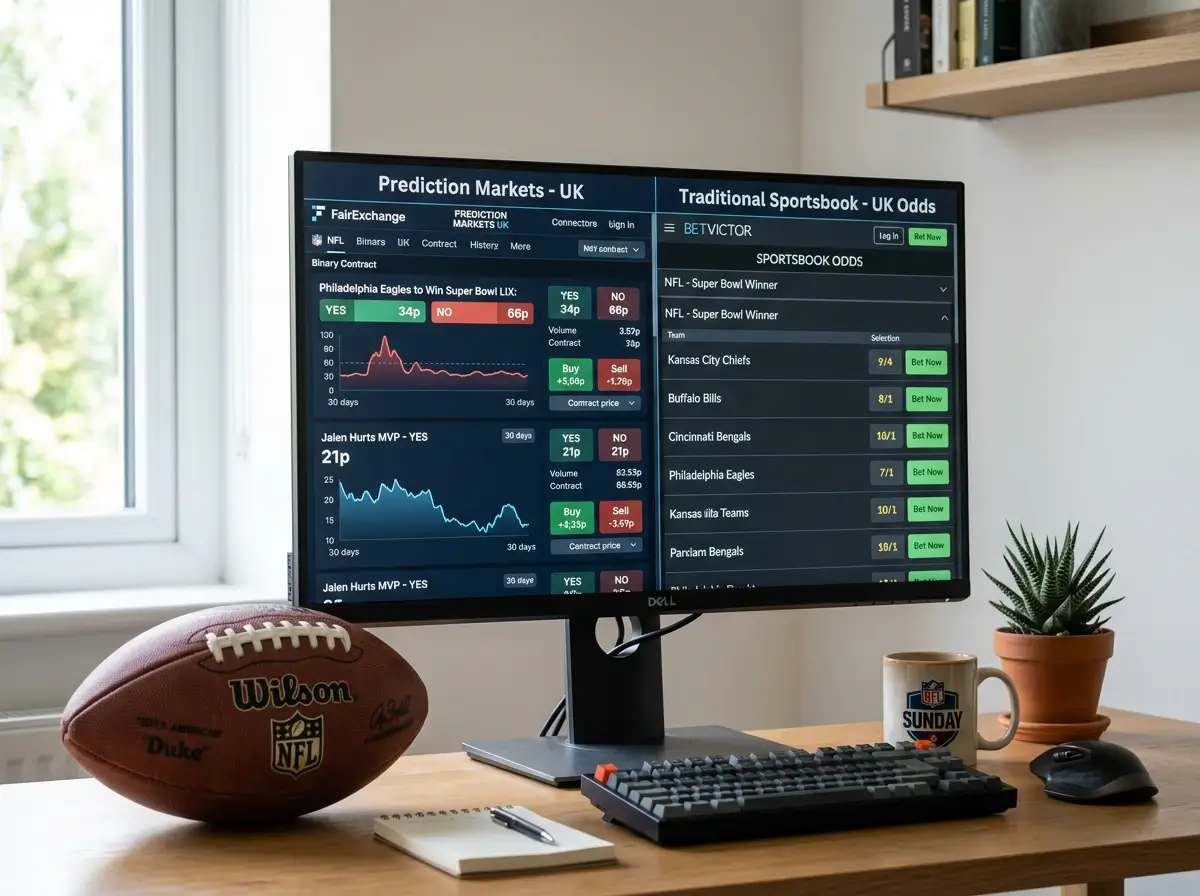
Bill Miller, the president and CEO of the American Gaming Association, did not mince words when he addressed the industry in early 2026. He called the rise of prediction markets “a defining fight” for the gaming sector, stating that “the battle against prediction markets” was one of the most pressing challenges facing licensed sportsbooks. That language — “battle,” “defining fight” — tells you everything about how seriously the traditional betting industry views these platforms. For UK punters watching the NFL, the emergence of prediction markets raises practical questions: what are they, how do they compare to your Bet365 account, and can you actually use them from Britain?
Prediction markets like Kalshi and Polymarket operate on a fundamentally different model from traditional sportsbooks. Instead of a bookmaker setting odds and taking the opposite side of your bet, prediction markets let participants trade binary outcome contracts — essentially buying “yes” or “no” shares on whether a specific event will happen. The price of each share reflects the market’s collective assessment of probability. If the event occurs, “yes” shares pay out at one dollar; if it does not, they expire worthless. The mechanism is closer to a stock exchange than a betting shop, and that distinction has profound regulatory and practical implications.
Prediction Markets vs Traditional Sportsbooks: How They Differ
The structural differences between prediction markets and sportsbooks go deeper than branding. At a sportsbook, the operator is your counterparty on every bet. They set the price, they manage their book, and their profit comes from the margin embedded in the odds. The overround guarantees the sportsbook makes money regardless of the outcome, as long as they balance their exposure reasonably well.
On a prediction market, there is no bookmaker. Participants trade directly with each other. If you buy a “yes” contract on “Kansas City Chiefs to win the Super Bowl” at 28 cents, someone else has sold you that contract at 28 cents. The market price is set by supply and demand, not by a bookmaker’s model. There is no built-in margin in the traditional sense — the platform takes a small fee on transactions or settlements, but the price itself is determined by the crowd.
The user experience also differs. On a sportsbook, you pick your outcome, enter your stake, and confirm. On a prediction market, you navigate an order book with bid and ask prices, choose your position size, and may need to wait for your order to be filled. The interface resembles a trading platform more than a betting app, which creates a steeper learning curve but also offers more sophisticated position management. You can exit a position before the event resolves by selling your contracts to another participant — something you cannot do at a sportsbook without using the operator’s cash-out feature, which always includes a margin against you.
For NFL specifically, prediction markets have gained traction for high-profile binary outcomes: who will win the Super Bowl, which team wins a specific game, over/under on total touchdowns. The market depth varies — Super Bowl contracts attract substantial volume, while Week 4 regular season matchups may trade thinly. This is analogous to the liquidity challenges that betting exchanges face for NFL markets in the UK.
Can UK Residents Use NFL Prediction Markets?
This is the critical question, and the answer is complicated. The UK Gambling Commission regulates all gambling activity offered to British consumers. Any platform offering gambling products to UK residents must hold a UKGC licence or face enforcement action. The UKGC has been aggressive in this space — the commission issued 741 cease-and-desist orders against unlicensed operators during 2025-2026 and reported approximately 398,000 illegal URLs to search engines for delisting.
Most major prediction market platforms, including Kalshi and Polymarket, are not UKGC-licensed. Kalshi operates under US Commodity Futures Trading Commission regulation, and Polymarket uses cryptocurrency-based infrastructure that sits outside traditional financial regulation. Neither is licensed to offer services to UK consumers. Accessing them from the UK falls into a legal grey area — you are unlikely to face personal prosecution for using an unlicensed platform, but you have zero consumer protection if something goes wrong. No recourse through the UKGC, no Financial Ombudsman, no guaranteed payout.
The FCA adds another layer of complexity. Some prediction market contracts could be classified as financial derivatives, which would bring them under FCA jurisdiction rather than UKGC oversight. The regulatory boundary between “gambling on sports” and “trading binary options on sporting outcomes” is genuinely blurred, and neither regulator has issued definitive guidance that resolves the ambiguity for UK residents.
The practical advice is straightforward: if you want the regulatory protections that UK law provides — guaranteed payouts, dispute resolution, responsible gambling tools, data protection — use a UKGC-licensed sportsbook or a UK-based betting exchange. If you choose to access prediction markets from the UK, understand that you are operating outside the regulated framework and accept the associated risks.
How Prediction Markets Influence Sportsbook Odds for NFL
Even if you never use a prediction market directly, their existence affects the prices you see at your sportsbook. Information flows between markets, and sharp bettors arbitrage discrepancies between prediction market prices and sportsbook odds. When a prediction market contract on “Chiefs to beat Eagles” trades at 62 cents (implying 62% probability) but the sportsbook prices the Chiefs at odds implying 58% probability, professional bettors pile into the sportsbook side until the price converges.
This convergence mechanism means prediction markets function as an alternative price-discovery tool. For NFL, where the volume of data and public information is enormous, prediction markets often reach efficient prices faster than sportsbooks because they aggregate a wider range of participants — including financial traders who bring different analytical approaches than traditional sports bettors. The result is that sportsbook NFL odds are indirectly influenced by prediction market prices, even if neither the sportsbook nor its customers are directly aware of the connection.
The US commercial gaming industry generated a record 78.72 billion dollars in revenue during 2025, with sports betting revenue alone growing 22.8% to nearly 17 billion dollars. Prediction markets represent a potential disruption to that growth, which is why the AGA and its member operators are lobbying aggressively for regulatory clarity. The outcome of that regulatory battle will shape the competitive landscape for NFL betting on both sides of the Atlantic.
For UK punters, the takeaway is more practical than political. Monitor prediction market prices as an additional data point when forming your NFL views. If the prediction market price on a game outcome diverges significantly from the sportsbook odds available to you, that divergence is worth investigating. It may indicate an information gap that the sportsbook has not yet priced in — or it may reflect differences in participant composition between the two markets. Either way, the information is free and the potential edge is real.
NFL Prediction Markets: Quick Answers
Prediction markets represent the most significant structural challenge to traditional sports betting in a generation. Whether they eventually integrate into the regulated UK framework or remain a parallel market is an open question, but their influence on NFL odds and betting strategy is already tangible. Understanding how they work gives you a broader view of the information landscape — even if you never buy a single contract yourself.
Are prediction markets legal for UK residents?
The legality is ambiguous. Major prediction market platforms like Kalshi and Polymarket are not licensed by the UK Gambling Commission, which means they are not authorised to offer services to UK residents. Using them is unlikely to result in personal legal consequences, but you have no consumer protection if the platform fails to pay out or disputes arise. For regulated alternatives, UK-based betting exchanges like Betfair offer some of the same peer-to-peer functionality within a UKGC-licensed framework.
How do prediction market odds compare to sportsbook odds for the NFL?
Prediction market prices frequently align closely with sportsbook odds for high-profile NFL events like the Super Bowl, because arbitrage activity pushes prices toward convergence. For regular season games, prediction market prices may differ more significantly from sportsbook odds due to thinner liquidity and different participant profiles. The absence of a bookmaker margin means prediction market prices can theoretically be more efficient, but the thinner volume for non-marquee NFL events can create wider bid-ask spreads that offset this advantage.
This material was created by the UK NFL Betting Analysis team.
Related posts

NFL Cryptocurrency Betting in the UK: Current Status and Regulatory Outlook

NFL Betting Mistakes That UK Punters Make — and How to Fix Them