
Accumulator Probability Calculations and Expected Returns Analysis
 Available in US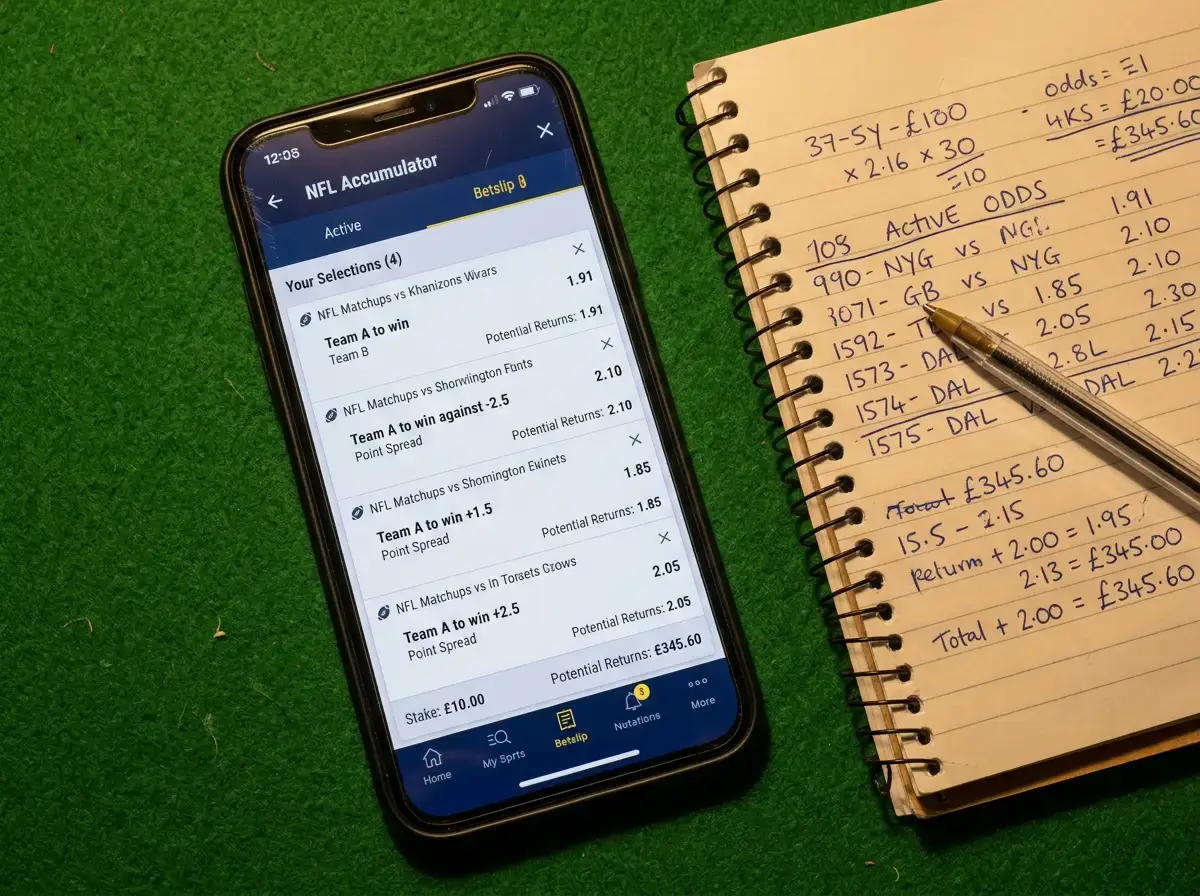
The first NFL parlay I ever placed was a four-leg accumulator on a Sunday afternoon in October. Four favourites on the spread, the kind of bet that feels like free money until the third leg collapses in the fourth quarter. I lost, obviously. But the exercise taught me something about accumulators that took two more seasons to fully appreciate: the appeal of parlays is not the big payout — it is the way they force you to think about multiple games simultaneously, which is either a strategic advantage or a very expensive hobby depending on how you approach the maths.
If you have placed an accumulator on the Premier League, you already understand the core mechanic of an NFL parlay. Different name, same DNA. You combine multiple selections into one bet, all of them need to win, and the combined odds produce a larger potential return than any single wager. In American terminology, this is a parlay. In British terminology, it is an acca. At UK sportsbooks, both terms appear interchangeably on NFL betslips, though “accumulator” remains the default label across most platforms.
What makes NFL parlays distinctive is the structure of the sport itself. With 13 to 16 games every Sunday during the regular season, the sheer volume of simultaneous events creates a natural parlay environment that no other major sport in the UK calendar can match. The question is whether that volume represents opportunity or merely temptation.
How NFL Parlays Work: Combining Multiple Selections
I built a five-leg NFL accumulator last December that returned just over GBP 300 from a GBP 10 stake. It was not skill — it was variance dressed up as a good Sunday. Understanding why that distinction matters starts with how the maths actually works.
An NFL parlay combines two or more independent selections into a single bet. Every leg must win for the bet to pay out. If even one leg loses, the entire parlay is settled as a loss. Most UK sportsbooks allow anywhere from two to fifteen selections in an NFL accumulator, though the sweet spot for serious bettors sits between two and four legs.
The odds compound multiplicatively. Take three NFL spread bets, each priced at 1.91 in decimal. Individually, a GBP 10 stake on each returns GBP 19.10. Combined as a parlay, your GBP 10 stake multiplies through: 1.91 x 1.91 x 1.91 = 6.97, returning GBP 69.70 from that same GBP 10. The jump from GBP 19.10 to GBP 69.70 is why parlays are popular. It is also why sportsbooks are happy to offer them — the house edge compounds right alongside your potential return.
If one leg of your accumulator is voided — typically because a game is postponed or an event within the bet is cancelled — UK sportsbooks reduce the parlay to the remaining active legs. A four-fold with one void becomes a treble. Your potential return drops, but the bet survives. This is standard practice across every UKGC-licensed operator I have used, though I always recommend checking the specific terms on your betslip before placing.
Minimum and maximum stakes vary, but most UK platforms set the floor at GBP 0.10 per parlay and the ceiling at GBP 500 or GBP 1,000 depending on the market. Maximum payouts cap between GBP 250,000 and GBP 2,000,000 at the larger operators. You will never hit those limits on a casual NFL acca, but it is worth knowing they exist.
Types of NFL Parlays Available at UK Sportsbooks
Not all accumulators are built the same, and the variety available for NFL markets at UK sportsbooks goes well beyond the standard “pick three winners” approach. I spent a season experimenting with every format I could find, and the differences in risk profile are more significant than most punters realise.
The standard accumulator is the bread-and-butter NFL parlay: pick your selections, combine them, and everything must win. Simple, binary, unforgiving. This is what most punters mean when they say “I had a parlay on the NFL this weekend.”
Round robin parlays break your selections into every possible smaller combination. If you choose four teams, a round robin generates all possible two-leg, three-leg, and four-leg parlays from those picks. Your total stake is higher because you are funding multiple bets, but you can profit even if one or two legs lose. It is insurance, paid for with a larger upfront commitment. Round robins are underused in NFL betting at UK sportsbooks, partly because the interface for building them is buried in most apps.
Cross-sport parlays let you combine NFL selections with bets from other sports — an NFL spread pick alongside a Premier League match result, for example. Most major UK operators support this, and it creates unusual combinations that can be entertaining for multi-sport weekends. The pricing typically carries a higher margin on cross-sport legs, though, so treat these as entertainment rather than strategy.
Then there are teasers, which are a modified form of parlay where you adjust the spread in your favour on each leg in exchange for reduced odds. Teasers deserve their own analysis and strategy, but the key distinction is that they give you a mathematical mechanism to improve your win probability per leg while accepting a lower payout — the opposite dynamic to a standard accumulator.
Expected Value of NFL Parlays: Why the Maths Matters
Here is the uncomfortable truth I had to confront after that GBP 300 win: over any meaningful sample, standard NFL parlays are negative expected value. The maths is not ambiguous about this. Every leg you add compounds the bookmaker’s margin, and the result is a bet where your actual probability of winning is always lower than the implied probability suggests.
Consider a two-leg NFL spread parlay where each side is priced at 1.91. The combined decimal odds are 3.65. The implied probability of hitting both legs at true 50/50 is 25%, but the payout reflects 27.4% implied probability. That 2.4-percentage-point gap is the house edge, and it only widens as you add legs. By the time you reach a five-fold, the compounded margin means you are effectively paying a 20%+ surcharge on your expected return.
When do parlays have positive expected value? Almost exclusively when you can identify correlated outcomes that the sportsbook has not fully priced. If heavy rain is forecast for an outdoor game and you combine the under on the total with a rushing-heavy team to cover the spread, those two outcomes share a common driver. Some sportsbooks price parlay legs independently, which means correlated legs can occasionally produce odds that overstate your true risk. This is the only structural edge in parlays, and it is both rare and increasingly difficult to exploit as sportsbook models improve.
The broader context is relevant too. A survey of over 1,200 active UK bettors found that 58.6% believe bonuses, odds, and promotions have deteriorated over the past year. That perception aligns with the reality of compounding margins in accumulator products — sportsbooks have quietly widened the gap between the odds offered and the true probability, particularly on popular products like NFL accas. If you are going to play parlays, do so with clear eyes about the cost and a strict bankroll allocation — I never risk more than 2% of my NFL season bankroll on any single accumulator.
NFL Parlay Betting: Quick Answers
Is a parlay the same as an accumulator in the UK?
Yes. Parlay is the American term, accumulator is the British term. Both refer to a single bet that combines multiple selections, all of which must win for the bet to pay out. UK sportsbooks use both terms interchangeably on NFL betslips.
What happens to my NFL parlay if one leg is void?
If one leg of your NFL accumulator is voided — due to a postponed game or cancelled market — the parlay reduces to the remaining active legs. A four-fold becomes a treble, and the potential return adjusts accordingly. The bet itself is not cancelled.
This material was created by the UK NFL Betting Analysis team.
Related posts

NFL Cryptocurrency Betting in the UK: Current Status and Regulatory Outlook

NFL Betting Mistakes That UK Punters Make — and How to Fix Them