Transatlantic Margin Comparisons and Vendor Licensing Restrictions
 Available in US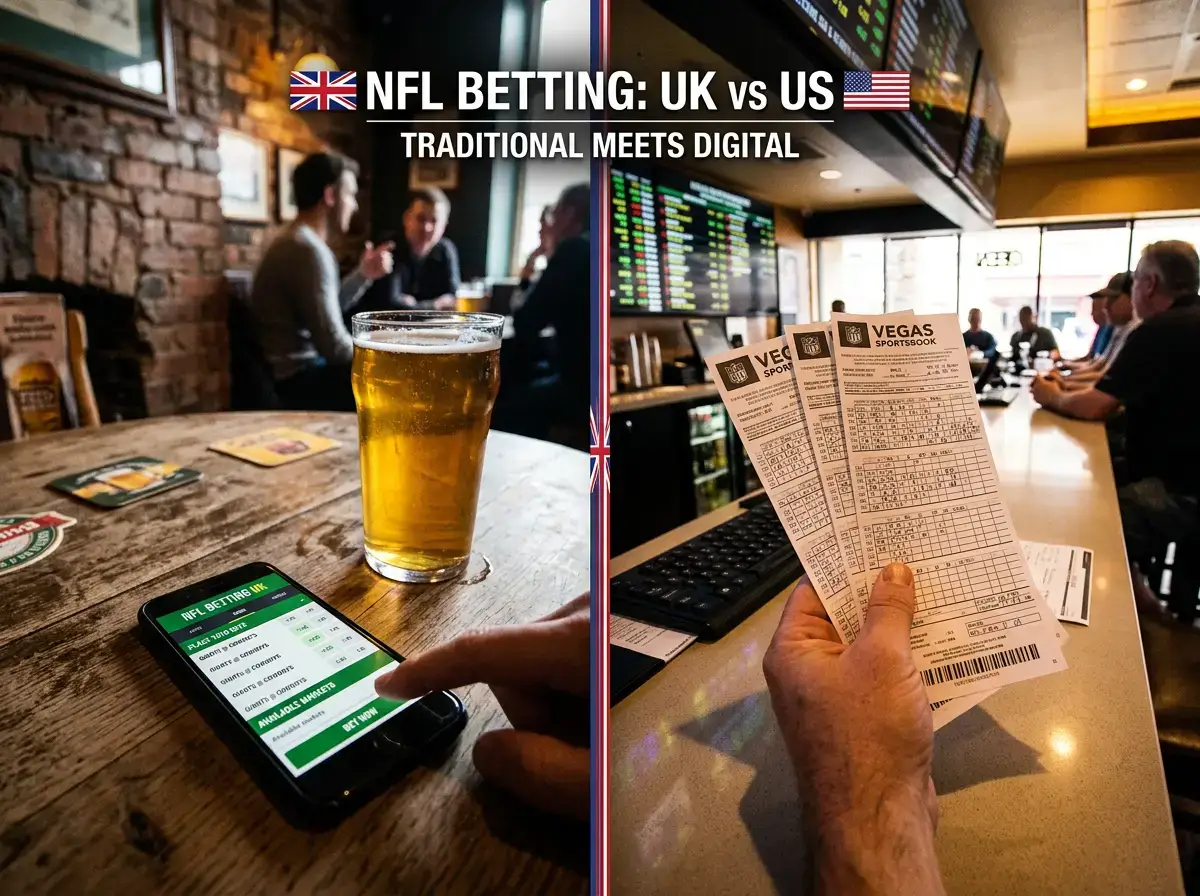
I was in Las Vegas for the 2024 Super Bowl, and the experience of placing an NFL bet there — walking into a sportsbook, handing over cash, receiving a paper ticket — felt like visiting a museum exhibit of how betting used to work. Back home, I had placed my pre-game bets on my phone that morning while making breakfast. The contrast was striking not because one system was better, but because the two markets have evolved along completely different paths despite regulating the same sport.
The US legal sports betting market generated 165.58 billion dollars in handle during 2025. The UK online gambling sector produced 7.8 billion pounds in gross gambling yield over a comparable period. Both are mature, heavily regulated markets with sophisticated consumers and intense competition among operators. But the regulatory frameworks, product features, odds formats, and tax structures differ so significantly that an NFL bettor moving between the two would barely recognise the same sport underneath. Understanding those differences is not just academic — it shapes what is available to you as a UK punter and highlights the specific advantages the British market offers.
Regulatory Framework: UKGC vs US State-by-State Model
The single biggest structural difference between UK and US NFL betting is regulatory architecture. The UK operates under a single national regulator — the UK Gambling Commission — which sets uniform rules for every licensed operator. Whether you bet in London, Manchester, or Edinburgh, the same affordability checks, the same consumer protections, and the same licensing standards apply. One licence covers the entire country.
The US has no equivalent national framework. Sports betting is regulated state by state, and more than 230 million Americans across 41 states and territories now have access to legal sports wagering. But the rules vary enormously. Some states allow mobile betting; others restrict it to physical locations. Tax rates on operator revenue range from single digits to over 50%. Promotional spending rules, bet types, and market restrictions all differ by jurisdiction. A DraftKings account in New Jersey operates under different rules than the same DraftKings account in Illinois.
For NFL bettors, the practical impact is that US punters face a fragmented experience where crossing a state line can change what is available to them, while UK punters enjoy a consistent, nationwide product. The UK’s affordability check regime — the 150-pound net deposit trigger — has no direct equivalent in the US, where individual states set their own player protection rules. Whether you view the UKGC’s approach as consumer protection or excessive nannying depends on your perspective, but the consistency is undeniable.
Odds Formats, Market Availability, and Product Features
The most visible difference is how odds are displayed. UK sportsbooks default to fractional odds (5/4, 10/11, 3/1), with decimal as an alternative. US sportsbooks use American odds (+150, -110, +300), which express the profit relative to a 100-unit stake. The underlying mathematics are identical — 5/4 fractional, 2.25 decimal, and +125 American all represent the same probability — but the presentation takes adjustment if you are accustomed to one format.
Product features diverge more meaningfully. Betting exchanges are a distinctly UK product — Betfair, Smarkets, and Betdaq have no direct US equivalents, and the peer-to-peer model where you can lay outcomes and trade positions is simply not available to American bettors. Financial spread betting through operators like Spreadex is another UK-only product, regulated by the FCA rather than a gambling authority. US bettors have nothing comparable.
Conversely, daily fantasy sports — platforms like DraftKings and FanDuel where you build rosters and compete against other players for cash prizes — have a much larger presence in the US than in the UK. While the products are available in Britain, the player pools are smaller and the prize structures less compelling. The cultural attachment to fantasy football (American) and fantasy football (Premier League) runs along national lines.
Bet builders — same-game multi-leg bets combining outcomes from a single fixture — are available in both markets but were pioneered and popularised by UK operators. The feature has since been adopted by every major US sportsbook, but the UK versions generally offer more flexibility in combining legs and a wider selection of qualifying markets for NFL.
Tax, Bonuses, and the Value Proposition for Bettors
UK bettors pay no tax on their winnings. All gambling profits in Britain are tax-free for the consumer, with the tax burden falling entirely on the operator through mechanisms like the Remote Gaming Duty and the statutory levy. The Remote Gaming Duty on online casino products was doubled from 21% to 40% effective April 2026, but this does not directly affect sports bettors — it pressures operator profitability, which may indirectly tighten promotional generosity and odds margins across the business.
In the US, the tax picture is completely different. Gambling winnings are taxable as income under federal law, and many states impose additional state-level taxes. A US bettor who wins a thousand-dollar NFL parlay owes federal income tax on the profit, and potentially state tax depending on where they live. This tax liability significantly reduces the effective return on winning bets for American punters, creating a structural advantage for UK bettors that is rarely discussed but mathematically substantial.
Promotional spending also differs. US sportsbooks, particularly in newly legal states, spend aggressively on sign-up bonuses, deposit matches, and risk-free first bets. The competition for new customers in a rapidly expanding market drives promotional generosity that exceeds what UK operators currently offer. However, the 58.6% of UK bettors who feel that bonuses and promotions have deteriorated may not appreciate the comparison — the US promotional landscape is driven by market growth dynamics that the mature UK market has already passed through.
The net value proposition for NFL bettors is surprisingly close. The UK offers tax-free winnings, exchange betting, financial spread betting, and a consistent national regulatory framework. The US offers larger promotional incentives, deeper NFL market liquidity (given the domestic audience), and no affordability checks. Neither market is definitively superior — each rewards different types of bettors with different priorities.
UK vs US NFL Betting: Quick Answers
The two markets are converging in some respects — bet builders, mobile-first interfaces, and in-play markets now look similar on both sides of the Atlantic. But the regulatory foundations and tax structures remain fundamentally different, and those foundations shape the product in ways that matter for your bottom line as a UK punter. Appreciate what the British market gives you — tax-free returns, exchange access, national consistency — and do not assume the American model is inherently better just because the numbers are bigger.
Can UK residents use American sportsbooks like FanDuel or DraftKings?
No. US-based sportsbooks like FanDuel and DraftKings require you to be physically located within a state where they are licensed to operate. They use geolocation technology to verify your position, and you cannot place bets from outside the US. UK residents must use UKGC-licensed sportsbooks for NFL betting. Some US brands have UK-facing products — Betfair is owned by Flutter Entertainment, which also owns FanDuel — but the UK and US products are separate platforms with separate licensing.
Are NFL betting odds better in the UK or the US?
Neither market consistently offers better odds. US sportsbooks generally have tighter spreads on NFL main markets due to the larger domestic audience and deeper liquidity. UK sportsbooks offer competitive odds on popular markets and sometimes better value on less liquid markets like early-week lines and player props. When you factor in the UK’s tax-free winnings versus the US tax liability on gambling profits, the effective return for UK bettors is often superior even if the headline odds are marginally worse.
This material was created by the UK NFL Betting Analysis team.
Related posts

NFL Cryptocurrency Betting in the UK: Current Status and Regulatory Outlook

NFL Betting Mistakes That UK Punters Make — and How to Fix Them