Correlated Event Synergies and Internal SGP Margin Accumulations
 Available in US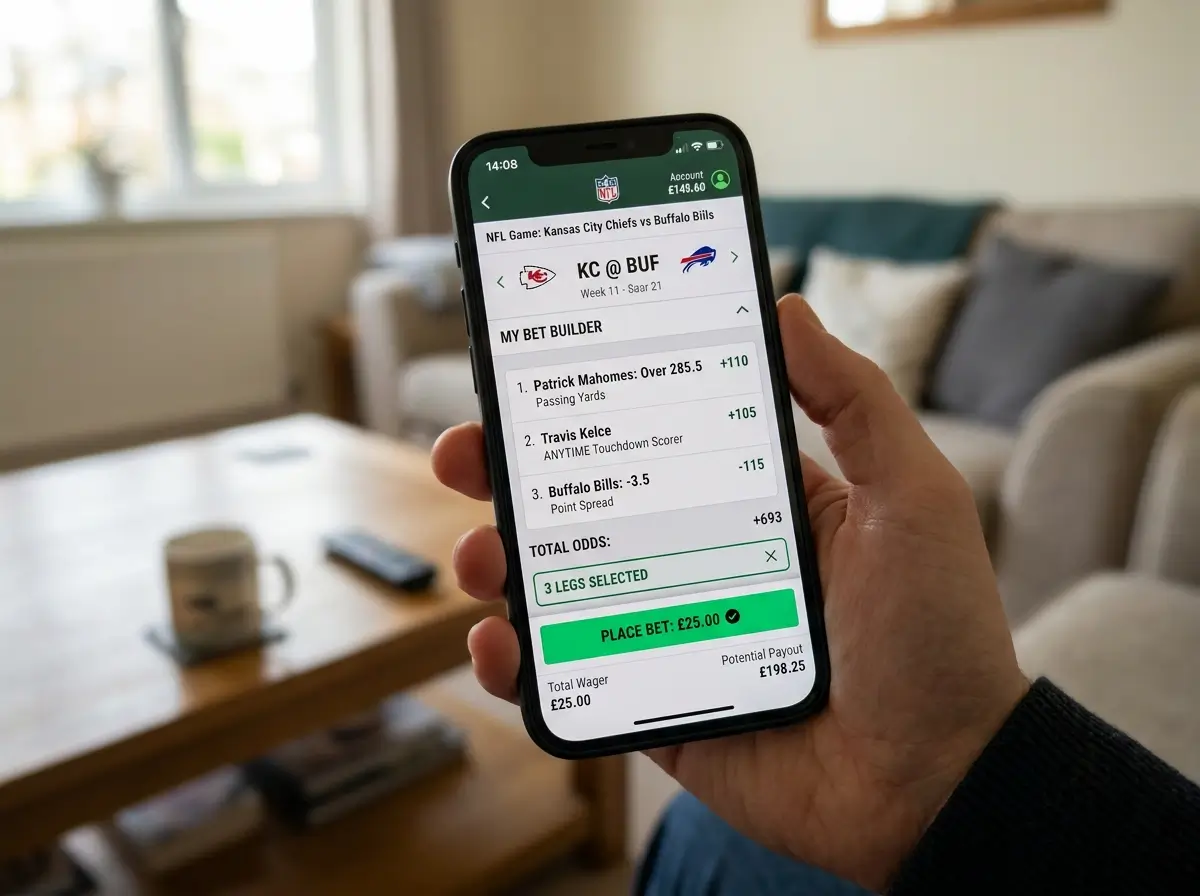
I placed my first NFL bet builder on a Thursday Night Football game in 2021 — Patrick Mahomes over 275 passing yards, Travis Kelce anytime touchdown scorer, and Chiefs -3.5. The combined odds looked enormous compared to backing each leg individually, and I felt like I had cracked some secret code. I had not. What I had done was hand the sportsbook a considerably wider margin than a standard single, and two of my three legs were so tightly correlated that the “value” was mostly an illusion. Five years on, I still use bet builders regularly for NFL, but the way I approach them has changed completely.
A bet builder — sometimes labelled a same game multi or SGM — lets you combine multiple selections from a single NFL match into one wager. Instead of backing the Kansas City spread on its own and then placing a separate player prop, you merge them into a single coupon with compounded odds. UK sportsbooks have invested heavily in this product because it drives engagement: 290.03 million online sports bets were placed per month across Britain in Q1 2025, and bet builders account for a growing share of that volume. The format suits American football particularly well. An NFL game generates dozens of individual markets — spreads, totals, player yardage, touchdowns, first scorer, drive outcomes — and the bet builder lets you weave them together in ways that feel personalised and fun.
This guide breaks down how NFL bet builders actually work behind the scenes, walks through a practical example of building one, and flags the mistakes that cost most punters money. If you already use bet builders for Premier League matches, the mechanics will look familiar — but NFL-specific quirks around correlation, market depth, and timing make it a different beast.
How NFL Bet Builders Work at UK Sportsbooks
The first time a mate asked me how bet builder odds are calculated, I gave the standard answer: “They just multiply the individual prices together.” That is partially true and completely misleading. Understanding what really happens inside the pricing engine changes how you evaluate these bets.
When you add selections to a bet builder, the sportsbook’s algorithm assesses each leg individually and then applies a correlation matrix. Correlation matters because outcomes within a single NFL game are not independent. If you back the Buffalo Bills -7.5 and the over 48.5 total points, those two outcomes are positively correlated — a team covering a big spread often contributes to a high-scoring game. The sportsbook knows this and adjusts the combined price downward. The legs that appear to offer the biggest combined odds are usually the ones with low or negative correlation, where hitting one leg makes the other less likely. A classic example: backing a team to cover -10.5 and the game to go under 38.5. Those outcomes can coexist, but the path is narrow.
Most UK sportsbooks require a minimum of two selections and cap the maximum somewhere between six and twelve, depending on the operator and the sport. NFL bet builders tend to have slightly more generous caps than football because the volume of available markets per game is larger. Each selection you add increases the overall margin the sportsbook takes. On a standard NFL spread bet, the overround might be 4-5%. On a four-leg bet builder, the effective margin can climb above 15-20%, because the correlation adjustment and the compounding of individual overrounds both work against you.
Pricing also varies between sportsbooks more than you might expect. Two operators can offer the same four-leg combination at noticeably different odds because their correlation models, base market prices, and margin policies differ. This is not a minor detail — on a 10 pound bet builder, the difference between 14/1 and 11/1 is significant. Checking the same combination across two or three apps before confirming takes thirty seconds and frequently reveals a gap worth exploiting.
Step-by-Step: Building an NFL Same Game Multi
Theory is useful, but nothing clarifies the process like walking through an actual build. Let me use a hypothetical Week 6 game: the Dallas Cowboys hosting the Philadelphia Eagles, with Dallas as 2.5-point home favourites and the total set at 45.5.
Start with your anchor leg — the selection you feel strongest about based on your pre-game research. For this example, I like the Eagles +2.5 because Philadelphia has covered in six of their last eight road divisional games and Dallas have been poor against the spread at home this season. That spread is the foundation of the bet builder, and everything else I add should complement it without contradicting the game script it implies.
Next, add a player prop that aligns with your expected game flow. If I think the Eagles keep it close or win outright, their running game is probably working. I will add Saquon Barkley over 74.5 rushing yards. This is mildly correlated with Eagles +2.5 — if Philly controls the clock on the ground, they are more likely to cover — but the correlation is moderate, not extreme. The sportsbook will adjust the price slightly, but it will not gut the odds the way a heavily correlated pair would.
Finally, I add a third leg that introduces a genuinely independent angle. CeeDee Lamb over 5.5 receptions is a volume play that depends on target share and game pace rather than which team covers the spread. Whether the Eagles win by three or the Cowboys win by four, Lamb is likely to see seven-plus targets. This leg has near-zero correlation with the spread, which means the combined price holds up better.
The final combination — Eagles +2.5, Barkley over 74.5 rushing yards, Lamb over 5.5 receptions — might price at around 5/1. I keep it to three legs because each additional selection adds margin and reduces my hit rate. A three-leg bet builder with a genuine edge on at least one leg is far more profitable over a season than a six-leg combination that looks exciting but statistically hits once in fifty attempts.
Common Mistakes in NFL Bet Builders and How to Avoid Them
Every Sunday during the NFL season, my social media feeds fill with screenshots of seven-leg bet builders that missed by one selection. The poster is always gutted. I am never surprised. The single biggest mistake I see UK punters make with NFL bet builders is adding too many legs. It feels harmless — “I’m just adding one more, the odds go from 8/1 to 18/1” — but each additional leg slashes the probability of the overall bet landing and fattens the sportsbook’s margin. Three legs is my ceiling for serious bets. Four if there is genuine analytical reasoning behind every selection. Five or more is entertainment, not strategy.
The second trap is over-correlation disguised as diversification. Backing a quarterback over on passing yards, his top receiver over on receiving yards, and the game over on total points feels like three different bets. It is essentially one bet: you need a high-volume passing offence in a shootout. If the live betting markets shift toward a defensive grind early in the first quarter, all three legs collapse together. Genuine diversification means mixing market types that have different underlying drivers — a spread pick, a rushing prop, and a defensive stat, for example.
Then there is the promoted bet builder problem. Sportsbooks regularly push pre-built “popular” bet builders with boosted odds. 58.6% of UK bettors already feel that promotional offers have deteriorated in quality over the past year, and bet builder boosts are no exception. The boosted price often looks generous until you calculate the implied probability of the underlying combination — the “boost” frequently just brings the odds closer to what they should be without the extra margin the sportsbook loaded in. Always price the legs individually before accepting a promoted build.
The final pitfall is ignoring game-specific context. NFL bet builders built on season-long stats miss the situational factors that drive individual games. A receiver’s yardage prop might look generous based on his season average, but if he is facing a shutdown corner this week or his team is coming off a bye with a revamped game plan, the season average is irrelevant. Treat each leg as a standalone analytical exercise, not a box-ticking process.
NFL Bet Builder: Quick Answers
NFL bet builders have become a core part of the UK sportsbook experience, and the product keeps evolving. Roger Goodell has spoken about the NFL’s long-term international ambitions — he has said the league wants to “put roots in” global markets and could eventually reach sixteen games in sixteen different markets. More NFL games, especially those kicking off at UK-friendly times, means more bet builder opportunities for punters on this side of the Atlantic. But the fundamentals stay the same: understand correlation, respect the margin, and never add a leg you cannot justify.
How many selections can I add to an NFL bet builder?
Most UK sportsbooks allow between two and twelve selections in a single NFL bet builder, though the exact cap varies by operator. Practically, three to four legs offers the best balance between attractive combined odds and a realistic chance of the bet landing. Each additional selection increases the sportsbook’s effective margin and dramatically reduces the probability of a full hit.
Do all UK sportsbooks offer bet builders for NFL games?
The majority of major UKGC-licensed sportsbooks now offer bet builders for NFL, including for regular season, playoffs, and the Super Bowl. Coverage tends to be thinner for Thursday and Monday Night Football compared to the full Sunday slate, and available markets may be more limited than what you would find for Premier League football. Checking two or three apps before building your bet ensures you get the widest selection of markets and the best combined price.
This material was created by the UK NFL Betting Analysis team.
Related posts

NFL Cryptocurrency Betting in the UK: Current Status and Regulatory Outlook
NFL Betting Mistakes That UK Punters Make — and How to Fix Them