Live British Sportsbook Pricing and Market Comparisons
 Available in US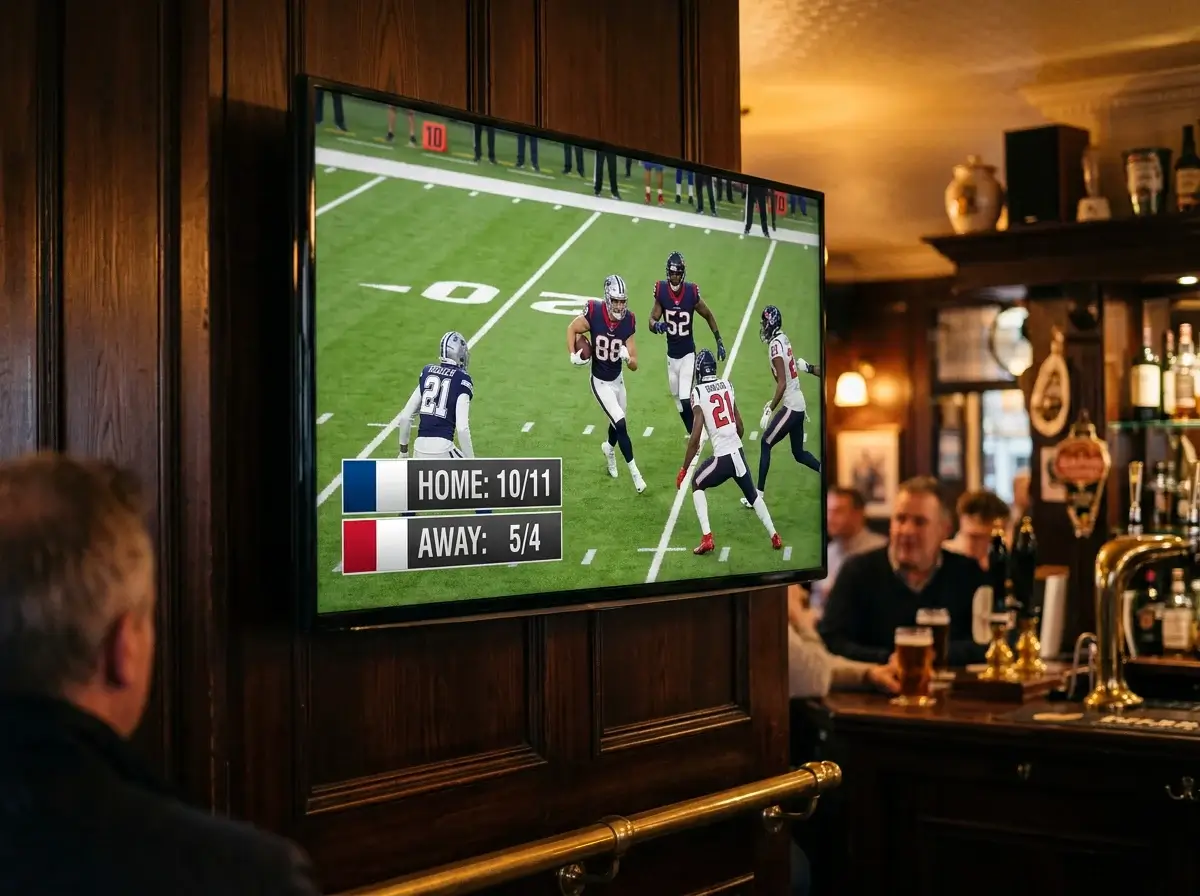
Sports betting accounts for 56.64% of all UK online gambling revenue, making it the largest and fastest-growing segment in the market. A significant chunk of that money is wagered by people who understand football odds instinctively but have never interrogated how odds actually work on a structural level. NFL forces that interrogation because the sport introduces market types — point spreads, totals, player props at scale — that price risk differently from anything in the Premier League ecosystem.
This article breaks down how UK sportsbooks build and adjust NFL odds, why the numbers look different from what you see on soccer markets, and how to read those numbers in a way that reveals genuine value rather than just the headline price. I will use concrete examples with real odds formats, walk through the maths behind bookmaker margins, and show you the specific patterns of line movement that create opportunities for UK punters who know where to look. Whether you have been betting on NFL for years or you are crossing over from football, the mechanics covered here apply to every wager you place on American football in Britain.
When comparing different pricing models, it is essential to understand the nuances between NFL spread betting vs fixed odds to maximize your potential returns.
Fractional vs Decimal Odds: Which Format UK Sportsbooks Use for NFL
Walk into any high-street bookmaker in Britain and the odds board shows fractional format — 5/1, 11/8, 4/6. That tradition carries over to online platforms, where fractional odds remain the default display for most UK sportsbooks. But open the settings panel on almost any modern betting app and you will find the option to switch to decimal or even American format. Knowing all three is not academic trivia — it is a practical skill that prevents misreading prices when you are comparing across platforms or referencing American sources.
Fractional odds express profit relative to stake. If you see 5/1, you profit five pounds for every one pound staked. The total return is six pounds. Simple enough for round numbers, but NFL markets frequently produce fractional odds that look awkward — 10/11, 5/6, 11/10 — because the underlying probabilities of spread bets cluster tightly around 50%. Here is a concrete example: a Kansas City Chiefs spread of -3.5 might be priced at 10/11 in fractional format. That means a ten-pound stake returns nineteen pounds and nine pence — ten pounds stake back plus nine pounds nine pence profit. Not exactly intuitive at a glance.
Decimal odds fold the stake into the return, making the maths cleaner. The same 10/11 fractional price converts to 1.91 in decimal. Multiply your stake by 1.91 and you get your total return. Ten pounds at 1.91 equals nineteen pounds ten pence. The decimal format is standard across continental European sportsbooks and is increasingly popular with UK punters who bet on multiple sports, precisely because the mental arithmetic is faster.
American odds are the format you will encounter on US-focused resources, podcasts, and analytics sites. They use a baseline of 100 — negative numbers indicate how much you must stake to win 100 units, positive numbers indicate how much you win from a 100-unit stake. The Chiefs at -3.5 priced at 10/11 (fractional) or 1.91 (decimal) translates to -110 in American format. A -110 line means you stake 110 to win 100. Conversion between formats is mechanical: decimal equals (fractional numerator / denominator) + 1. For American to decimal: if the American odds are negative, decimal equals (100 / absolute American odds) + 1; if positive, decimal equals (American odds / 100) + 1.
Most UK sportsbooks default to fractional but allow switching in user settings. My recommendation for NFL betting is to use decimal. The reason is practical, not philosophical — when you are comparing odds across three or four sportsbooks on a Sunday morning, decimal format lets you spot the best price instantly because the numbers are directly comparable. Fractional odds like 10/11 versus 5/6 versus 19/20 require conversion before you can tell which is highest. Decimal equivalents of 1.91, 1.83, and 1.95 make the answer obvious at a glance.
How UK Sportsbooks Set and Adjust NFL Odds
I once watched an NFL spread move a full point in the twenty minutes between pouring a cup of tea and sitting down to place the bet. That kind of movement is routine in American football betting, but understanding why it happens — and who triggers it — separates informed punters from those who are simply reacting to numbers on a screen.
NFL odds at UK sportsbooks originate from a combination of proprietary pricing models and licensed data feeds. The single most important data relationship in the NFL betting ecosystem is between the league and Genius Sports, which holds an exclusive contract to distribute official NFL play-by-play data to sportsbooks worldwide through to Super Bowl 2030. That deal means every licensed UK operator receiving real-time NFL data is getting it from the same source. The starting point for odds is therefore broadly similar across the market — what differs is how each operator’s trading team interprets and adjusts those numbers.
Opening lines for a typical NFL week appear on Tuesday or Wednesday, roughly five days before the Sunday kickoffs. These initial prices reflect the trading team’s assessment based on team form, injuries reported up to that point, historical matchup data, and early sharp market activity from US-facing sportsbooks. UK sportsbooks generally set their opening lines with reference to the US market — the sheer volume of American NFL handle (an estimated $30 billion across the 2025 season) means the US lines carry enormous weight. A UK book is unlikely to stray far from the US consensus, because doing so creates arbitrage opportunities that sharp bettors will exploit within minutes.
Between opening and kickoff, odds adjust based on three primary drivers. First, betting volume — if a disproportionate amount of money lands on one side of a spread, the operator moves the line to rebalance exposure. Second, information — injury updates, weather reports, and lineup announcements all trigger re-pricing. Third, sharp money — when recognised professional bettors place significant wagers, many sportsbooks adjust immediately, sometimes before the public has processed the same information.
NFL odds move differently from Premier League odds, and the distinction is worth understanding. Football matches generate continuous betting volume from a global audience across overlapping time zones. NFL games concentrate their action into a narrower window — most UK betting volume hits between Saturday afternoon and Sunday evening — creating sharper, more abrupt line movements. A Premier League spread might drift gradually over 48 hours. An NFL spread can jump a full point in an hour if a starting quarterback is listed as questionable on the Friday injury report.
For UK punters, this cadence creates a specific timing opportunity. Lines posted on Tuesday or Wednesday are often softer than the same lines on Sunday morning, because the volume of sharp money that refines those prices has not yet arrived. I have found consistent value in placing NFL bets midweek rather than waiting for the weekend — a habit that contradicts the instinct to wait for the most information before committing.
NFL Odds Breakdown by Market Type
Not all NFL odds are built the same. The price you see on a moneyline bet and the price on a first touchdown scorer prop reflect completely different risk profiles for the sportsbook, which translates into dramatically different margins embedded in the odds. Understanding those differences is the single fastest way to improve the value of your NFL betting, because it tells you where the operator is taking a larger cut and where the pricing is tighter.
Point spreads are the backbone of NFL betting, and they carry the tightest margins. A standard spread market is priced at 10/11 on each side in fractional terms (1.91 decimal), which implies a bookmaker margin of roughly 4.5% to 5%. This is competitive by industry standards — Premier League match result markets often carry similar or slightly wider margins. The spread market is tight because it attracts the highest volume and the sharpest bettors, forcing operators to price accurately or face costly exposure.
Totals — the over/under on combined points scored — are priced similarly to spreads, typically at 10/11 or occasionally 5/6 on each side. The margin structure mirrors the spread because totals attract a comparable level of informed betting action. Where spreads and totals diverge is in their sensitivity to late-breaking information. A starting quarterback ruled out affects the spread more than the total; a weather forecast showing 40-mph winds at kickoff hammers the total while leaving the spread relatively stable.
Moneyline odds on NFL games show wider variation because the margin is asymmetric. In a closely matched game, both sides might be priced around 10/11 (1.91), keeping the margin tight. But in a lopsided matchup — say, a 14-point favourite — the favourite’s moneyline might sit at 1/7 (1.14) while the underdog is 9/2 (5.50). The implied probabilities of those two prices add up to well over 100%, and the margin balloons to 6% or more. Moneyline betting on heavy favourites is almost always poor value because the operator’s cut is hidden in the compression of already-short prices.
Player props occupy a higher-margin tier. First touchdown scorer markets, passing yardage over/under lines, and reception totals are priced with margins ranging from 8% to 15%. The reason is data uncertainty — individual player performance carries more variance than team outcomes, and the sportsbook prices that uncertainty into the odds. Props are also where operators face the least sharp action, because professional bettors tend to focus on spreads and totals where edge calculation is more straightforward. For recreational punters, props are entertaining but structurally expensive.
Futures sit at the widest-margin end of the spectrum. A Super Bowl winner market opened in March might carry a total overround exceeding 130%, meaning the bookmaker’s theoretical margin is 30% or more. The margin narrows as the season progresses and the field shrinks, but early-season futures are among the most expensive bets a UK punter can place in terms of embedded cost. That does not make them worthless — a well-timed futures bet placed before the market has fully priced in off-season roster changes can carry genuine value — but it means the starting position is steep.
Understanding the Bookmaker Margin on NFL Markets
The bookmaker margin — also called the overround or vig — is the operator’s built-in advantage on every market. Calculating it is straightforward, and doing so regularly is the single most practical habit I recommend to anyone betting on NFL in the UK.
Take a two-outcome market: Team A to cover the spread at 10/11, Team B at 10/11. Convert each to implied probability. 10/11 in decimal is 1.91, and the implied probability is 1 divided by 1.91, which equals 52.36%. Add both sides: 52.36% + 52.36% = 104.72%. The amount above 100% — here, 4.72% — is the bookmaker’s margin. On a perfectly efficient market, the two probabilities would sum to exactly 100%. The surplus is the operator’s theoretical profit.
For NFL spreads priced at 10/11 each side, a margin of 4.5% to 5% is standard. Compare that to an NFL player prop market where one side is priced at 4/5 (1.80) and the other at 4/5 (1.80). Implied probabilities: 55.56% + 55.56% = 111.11%. That is an 11% margin — more than double the spread market. You are paying twice as much in embedded cost for the privilege of betting on a player prop versus a spread.
This matters because most casual NFL bettors gravitate toward props and novelty markets precisely because they are exciting. First touchdown scorer, anytime scorer, total passing yards — these markets are fun but structurally expensive. The discipline of checking the margin before placing a bet does not eliminate the entertainment value, but it does ensure you know the price of admission. Over a full NFL season of 18 regular-season weeks plus playoffs, the difference between consistently betting at 5% margin versus 12% margin compounds into a significant drag on your bankroll.
Comparing NFL Odds Across UK Sportsbooks: A Practical Method
Here is the uncomfortable truth about NFL betting in Britain right now: 58.6% of active UK bettors surveyed in April 2026 reported that odds, bonuses, and promotions have deteriorated over the past year. That is not anecdotal grumbling — it is a data point from a survey of over 1,200 active players. Bill Miller, president of the American Gaming Association, acknowledged a broader industry challenge when he noted that while 2025 was another strong year for commercial gaming, the battle against prediction markets represents a defining fight for the sector. The competitive pressure that once drove sportsbooks to sharpen their NFL prices has shifted, and punters are noticing.
The antidote is systematic comparison. Not the vague “shop around for the best odds” advice that every competitor site repeats, but a concrete method you can apply in under five minutes on any NFL game day.
Start by converting all odds to decimal format. This eliminates the cognitive overhead of comparing fractional expressions. Open three or four sportsbook accounts — this is free and takes minutes — and navigate to the same NFL game on each. Pick a specific market: the point spread on the Sunday afternoon game, for example. Record the decimal price for each side at each sportsbook. Calculate the implied probability for each side, then add them together. The sportsbook with the lowest total overround on that market is offering the most efficient prices.
Here is a worked example. Sportsbook A prices a spread at 1.91 / 1.91. Implied probabilities: 52.36% + 52.36% = 104.72%. Sportsbook B prices the same spread at 1.87 / 1.95. Implied probabilities: 53.48% + 51.28% = 104.76%. Sportsbook C prices it at 1.95 / 1.87. Implied probabilities: 51.28% + 53.48% = 104.76%. In this case, the margins are nearly identical — but Sportsbook C offers the best price on the side you want to back (1.95 versus 1.91). The comparison tells you both the overall margin and which operator gives you the best price on your specific selection.
I run this exercise every week during the NFL season for two or three games I plan to bet on. The time investment is minimal — under ten minutes once you have accounts set up — and the cumulative impact over 18 weeks is measurable. A consistent 0.04-point improvement in decimal odds across 50 bets at an average stake of twenty pounds is forty pounds of additional value. Not life-changing, but it is money that was already sitting on the table.
For a deeper look at how point spread mechanics affect the prices you see across different operators, including key number analysis and half-point pricing, the dedicated spread guide covers the structural details.
NFL Odds Movement Patterns That UK Bettors Should Track
There is a window every Wednesday morning, around 10:00 GMT, when I check NFL lines before most of the UK betting public has even thought about the weekend’s games. The lines posted at that point are usually softer — closer to the opening numbers that US books released overnight — and the sharpest moves have not yet filtered through to UK platforms. By Friday afternoon, after the first wave of injury reports and US-based sharp action, those same lines look very different.
NFL line movement follows a predictable weekly rhythm because the sport itself runs on a rigid schedule. Tuesday: opening lines appear at major US sportsbooks, and some UK operators post corresponding markets by midday. Wednesday and Thursday: the first injury reports drop (NFL teams must publish practice participation reports on Wednesday, Thursday, and Friday), triggering initial adjustments. Friday afternoon: the official injury designations (out, doubtful, questionable, probable) are released, causing the week’s largest single wave of movement. Saturday: late adjustments based on final roster confirmations. Sunday morning: last-minute weather and inactive list announcements compress what remains of the movement into the final hours before kickoff.
The trigger that produces the most dramatic movement is a starting quarterback’s injury status. When a QB is listed as questionable on Friday and then downgraded to out on Saturday, the spread can shift by three or more points within hours. This is more movement than you see across an entire week of Premier League markets for a comparable event (like a striker being ruled out). The reason is structural: in the NFL, a single player — the quarterback — has a disproportionate impact on the team’s expected scoring output. No other major sport concentrates that much influence in one position.
Reverse line movement is the pattern that sharp bettors track most closely. It occurs when the line moves in the opposite direction to where the majority of public bets are falling. If 70% of bets are on Team A to cover the spread, but the line moves in Team B’s favour, it suggests that a smaller volume of money from sharper sources is outweighing the public action. Reverse line movement is not a magic signal — it does not guarantee an outcome — but it is a reliable indicator that professional money disagrees with recreational consensus.
For UK punters specifically, the timezone creates a structural advantage. The busiest period for NFL odds movement at US sportsbooks is Saturday afternoon through Sunday morning, American time. That corresponds to Saturday evening through Sunday afternoon in the UK. If you are checking lines on a Saturday evening in London, you are catching the final wave of sharp US movement in real time, while much of the UK recreational betting public is still planning to place their bets on Sunday morning. That window — Saturday 20:00 to Sunday 10:00 GMT — is when I have found the most consistent value across nine seasons of NFL betting from the UK.
For a comprehensive overview of the market, check out our main guide to UK online betting for NFL before placing your wagers.
NFL Odds UK: Your Questions Answered
Why do NFL odds look different from Premier League odds?
NFL betting is structured around point spreads and totals rather than match result markets. A Premier League game typically offers three-way odds (home, draw, away), while an NFL game centres on a two-way spread where both sides are priced near even money — typically 10/11 or 1.91 in decimal. The spread eliminates the equivalent of a draw by adding a handicap, which changes the odds structure entirely. Player prop and futures markets also feature more prominently in NFL than in football, each carrying different margin profiles.
What is the typical bookmaker margin on an NFL spread bet?
Most UK sportsbooks price NFL spreads at 10/11 on each side, which produces a margin of approximately 4.5% to 5%. This is comparable to Premier League match result margins. Player props carry higher margins, typically 8% to 15%, and futures markets can exceed 20% to 30% when many teams are still in contention. The spread market is the tightest because it attracts the highest betting volume and the most informed action.
When is the best time to place an NFL bet for the best odds?
Early-week lines — posted Tuesday or Wednesday at UK sportsbooks — are generally softer than Sunday morning prices because they have not yet been shaped by the full week of sharp money, injury reports, and public betting volume. The period between Saturday evening and Sunday mid-morning GMT is another productive window, as UK punters can capture the final wave of US sharp line movement before domestic recreational action begins. Both windows offer better pricing than placing bets during the final hour before kickoff.
Do UK betting exchanges offer better NFL odds than traditional sportsbooks?
Exchanges like Betfair allow you to bet against other punters rather than against the sportsbook, which often produces tighter margins on high-liquidity markets. For NFL spreads and moneylines on major games, exchange odds can be sharper than traditional book prices. The trade-off is that NFL liquidity on UK exchanges is significantly lower than for Premier League football, meaning you may not get your full stake matched on less popular games or markets, and in-play exchange betting on NFL is noticeably thinner than on soccer.
This material was created by the UK NFL Betting Analysis team.
Related posts

NFL Cryptocurrency Betting in the UK: Current Status and Regulatory Outlook

NFL Betting Mistakes That UK Punters Make — and How to Fix Them