Meteorological Line Adjustments and Outdoor Totals Re-Pricing
 Available in US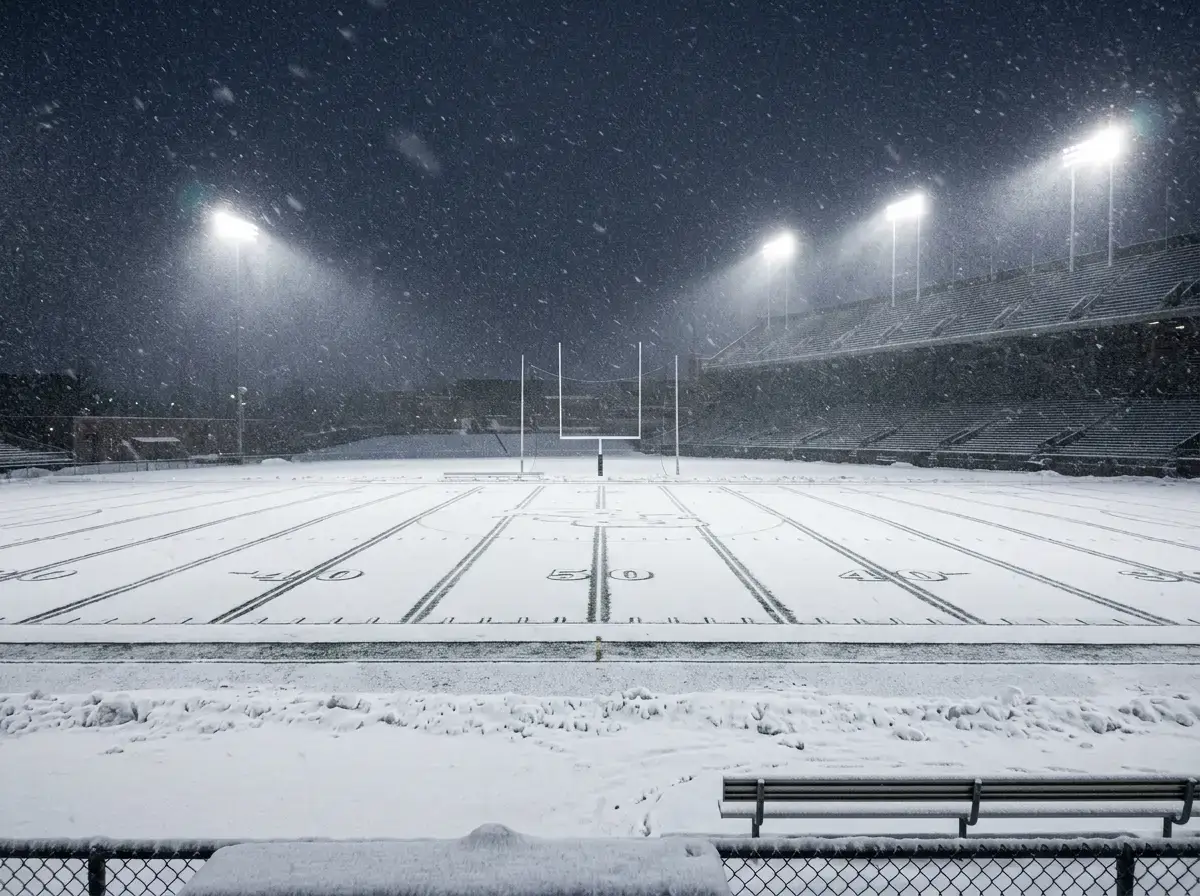
Weather is the single most underutilised edge in NFL betting, and it is especially underexploited by UK punters. Sixteen of the NFL’s 32 teams play in outdoor stadiums where wind, rain, snow, and temperature directly affect the game. The conditions change week to week, they are knowable in advance, and they systematically affect scoring patterns in ways that sportsbook lines do not always fully capture. If you spend five minutes checking the forecast before every outdoor game, you are already ahead of the vast majority of the market.
High winds and freezing temperatures heavily suppress scoring, which is a vital factor when applying NFL totals betting strategies.
Wind Speed and NFL Passing: When Totals Drop
Wind is the single most impactful weather variable for NFL betting, and the effect is more dramatic than most bettors realise. The critical threshold is roughly 15 miles per hour of sustained wind. Below that, the impact on passing is negligible — quarterbacks train in moderate wind and adjust their mechanics accordingly. Above 15 miles per hour, the deep passing game degrades measurably. Above 20, it becomes unreliable. Above 25, even short and intermediate passes lose accuracy, and the kicking game — field goals and punts — becomes genuinely unpredictable.
The mechanism is straightforward. A football in flight is significantly affected by crosswinds and headwinds. A 40-yard pass that normally drops into a tight window becomes a 40-yard pass that sails two metres beyond the receiver. Deep shots downfield — the high-variance, big-play passes that inflate scoring — become low-percentage gambles that most offensive coordinators eliminate from the game plan. The result is a compressed, ground-oriented game where drives take longer, possessions end in punts more frequently, and the total score drops.
For over/under betting, the wind threshold is a binary indicator. If sustained winds are forecast above 15 miles per hour at kick-off, look at the under. If the sportsbook total has not been adjusted downward to reflect the wind — and it often has not, particularly on less high-profile games where the line-setting team may not have factored localised conditions — the value is almost always on the under side. The larger the wind speed above the 15-mile-per-hour threshold, the stronger the signal.
Kicking is the other casualty. Field goal accuracy drops in high wind, and the direction of the wind relative to the goalposts matters. A kicker facing a headwind on one end of the field has a materially different probability of converting a 45-yard attempt than when kicking with the wind. Prop markets on total field goals made and individual kicker performance are directly affected, though the sportsbook pricing on these niche markets is often less responsive to weather conditions than the main total line.
Snow, Rain, and Freezing Temperatures: Betting Adjustments
Snow games are the most visually dramatic weather events in the NFL, and they generate the most volatile betting outcomes. Heavy snow affects visibility, footing, and ball security. Receivers struggle to run precise routes on snow-covered turf, defensive backs lose their footing on breaks, and the ball becomes slippery in wet, cold conditions. Fumble rates increase measurably in snow games, which adds an element of chaos that benefits underdogs.
Rain has a more subtle but consistent effect. A wet ball is harder to grip and harder to throw accurately, which reduces passing efficiency across the board. Running backs benefit from the reduced ability of defenders to tackle cleanly on wet surfaces, so the running game becomes more prominent. The practical betting adjustment mirrors the wind analysis: look at the under in significant rain, and consider the impact on passing-dependent offences when evaluating the spread.
Freezing temperatures primarily affect teams that are not accustomed to them. A dome team travelling to Green Bay in December faces conditions that are genuinely foreign — not just uncomfortable, but operationally disruptive. Receivers’ hands lose feeling, quarterbacks struggle to grip the ball, and players who have trained in climate-controlled facilities all season are suddenly playing in minus-five conditions. The home team has a built-in advantage in these scenarios that goes beyond standard home-field advantage — they have practiced in the cold, their bodies are acclimated, and their game plan is designed around the conditions.
Late-season scheduling creates the most reliable cold-weather angles. Games in Green Bay, Chicago, Buffalo, and New England from November through January feature the most extreme temperature conditions, and the visiting team’s identity matters enormously. A Miami team travelling to Buffalo in January is a qualitatively different proposition than a Pittsburgh team making the same trip. The warm-weather or dome-team-on-the-road-in-winter angle is one of the most persistent edges in NFL situational betting.
Dome Teams Outdoors: A Measurable Betting Angle
Teams that play their home games in enclosed stadiums — currently including the Rams, Chargers, Cardinals, Cowboys, Texans, Falcons, Saints, Lions, Vikings, Raiders, and Colts — have a measurable performance differential when they travel to outdoor venues in adverse weather. The effect is strongest when the temperature drops below freezing or when precipitation combines with wind.
The record London attendance of 86,152 at the 2025 Rams-Jaguars Wembley game illustrated an interesting variant of this angle. London’s weather is unpredictable but rarely extreme — the temperature is mild by NFL standards, but the dampness and the unfamiliar outdoor environment can still affect dome teams. With 39 regular season games played in the UK since 2007, there is now a meaningful sample of outdoor neutral-venue data that can inform how dome teams perform outside their controlled home environment.
The betting adjustment for dome teams outdoors should focus on the total rather than the spread. Dome teams do not necessarily lose more often outdoors, but their offensive output tends to decline because their passing schemes are optimised for indoor conditions — precise route-running, tight-window throws, and high completion percentages that depend on consistent footing and ball grip. When those conditions are removed, the offensive ceiling drops. The under on the team total for a dome team visiting an outdoor stadium in bad weather is one of the more reliable situational angles in NFL betting.
Find the most accurate statistical breakdowns and market analysis at the leading American football betting hub in the UK.
NFL Weather Betting: Quick Answers
Weather analysis takes five minutes per game and can be the difference between a winning and losing Sunday. Check the forecast for every outdoor fixture, focus on wind speed as the primary variable, and adjust your total and passing-related prop bets accordingly. The data is free, the edge is real, and the majority of your competition is not bothering to look.
Where can I check NFL game-day weather forecasts?
Weather Underground and the US National Weather Service both provide hour-by-hour forecasts for every city with an NFL team. Several dedicated NFL weather websites aggregate this data specifically for bettors, showing wind speed, temperature, and precipitation probability for each outdoor game. Check forecasts on Saturday evening UK time for the most accurate game-day conditions, as weather models become significantly more reliable within 24 hours of kick-off.
How much does wind affect NFL passing yardage?
Wind speeds above 15 miles per hour begin to measurably reduce passing yardage. Above 20 miles per hour, the deep passing game becomes unreliable, with quarterbacks limiting attempts beyond 20 yards downfield. Above 25 miles per hour, even intermediate passes lose accuracy, and games tend to become heavily run-focused. The impact on total scoring is most pronounced above the 20-mile-per-hour threshold, where games consistently finish under the posted total at a rate that exceeds random expectation.
This material was created by the UK NFL Betting Analysis team.
Related posts

NFL Cryptocurrency Betting in the UK: Current Status and Regulatory Outlook
NFL Betting Mistakes That UK Punters Make — and How to Fix Them