Mandatory Capital Protection Features and Restrictive Timers
 Available in US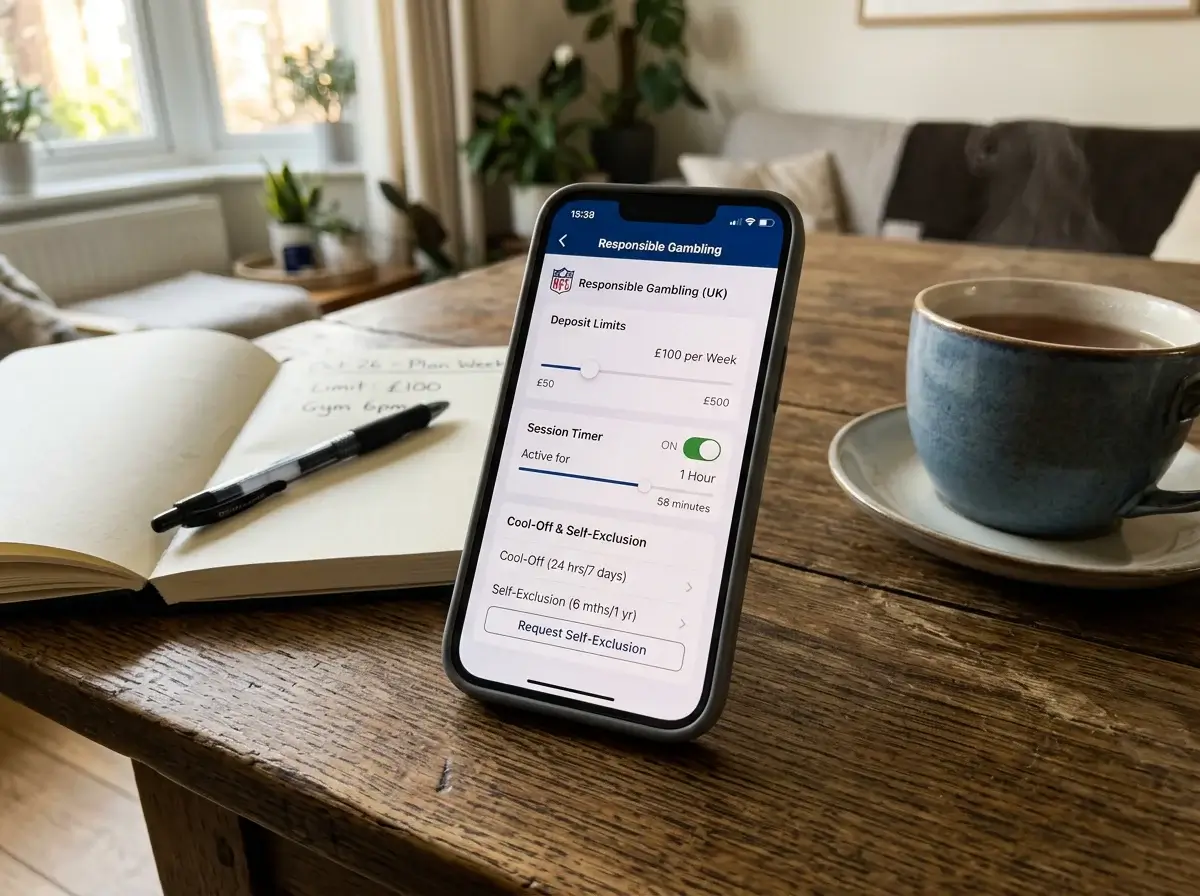
I have a rule that I have never broken in nine years of NFL betting: if I check my sportsbook app more than twice during a game I do not have a bet on, something has shifted in my relationship with gambling that week. Not a crisis, not a disaster — just a signal that the habit is drifting from analytical engagement toward compulsive checking. That awareness did not come naturally. I developed it after a 2020 playoff weekend where I caught myself placing bets on games I had not researched, purely because the app was open and the “place bet” button was right there.
Nearly 48% of British adults gamble at least once a month. The NFL season runs from September through February, overlapping with Christmas, New Year, and some of the most financially stressful months of the calendar year. The combination of weekly betting opportunities, easily accessible mobile apps, and the emotional intensity of a sport built around high-stakes moments creates a specific set of risks that deserve honest discussion. This guide covers the tools available to manage those risks, the NFL-specific patterns that can escalate gambling behaviour, and how to set boundaries that protect your enjoyment of both the sport and the wagering.
GAMSTOP and Self-Exclusion: How They Apply to NFL Betting
GAMSTOP is the UK’s national self-exclusion scheme for online gambling. When you register with GAMSTOP, all UKGC-licensed online gambling operators are required to prevent you from opening new accounts or placing bets for your chosen exclusion period: six months, one year, or five years. The scheme covers every licensed sportsbook, casino, bingo site, and lottery platform operating in the UK. There is no partial exclusion — you cannot block yourself from casino products while keeping your NFL betting accounts active. It is all or nothing.
For NFL bettors specifically, the timing of GAMSTOP registration matters. If you register in September at the start of the NFL season, you are locked out until at least March — which covers the entire regular season and playoffs but allows you to return before the next season begins, depending on the exclusion period you chose. If you register for six months in February, you miss the Super Bowl but are free to return for the September kickoff. The point is not to game the system; the point is that if you are considering self-exclusion, the NFL calendar creates natural decision points where the choice feels more manageable than an indefinite commitment.
The financial impact of gambling is particularly stark among younger demographics. Research indicates that the average UK student who gambles loses 35.25 pounds per week — almost exactly equal to their average weekly food spending of 36 pounds. That statistic is not NFL-specific, but it illustrates the scale of financial harm that gambling can inflict on vulnerable groups. University students who develop NFL betting habits during freshers’ season may find that the weekly rhythm of the sport — with its constant stream of new games, new lines, and new promotional offers — accelerates spending in ways that other sports do not.
Individual operator self-exclusion is also available. Every UKGC-licensed sportsbook offers the option to self-exclude from that specific platform, typically for periods of six months to five years. This is less comprehensive than GAMSTOP but allows you to remove yourself from a particular operator that you find problematic while maintaining access to others. Some punters use this to close accounts where they have developed unhealthy patterns while keeping a single account with strict controls in place.
Setting Deposit Limits, Loss Limits, and Session Timers
Every UKGC-licensed sportsbook is required to offer deposit limits, and most also provide loss limits and session time alerts. These tools are found in the account settings or responsible gambling section of your app, and they take effect immediately when reduced and after a cooling-off period when increased. The cooling-off period is important — it prevents you from raising your limits in the heat of a losing Sunday and immediately depositing more money.
For NFL betting, I recommend setting a weekly deposit limit that matches your planned unit size multiplied by the maximum number of bets you typically place in a week. If your unit size is ten pounds and you average five bets per Sunday, a fifty-pound weekly deposit limit keeps your activity within your planned bankroll. The limit acts as a structural constraint that removes the decision from the emotional moment. You do not have to choose whether to deposit more after a bad afternoon — the limit has already made that choice for you.
Loss limits work similarly. Set a weekly loss limit that you are genuinely comfortable absorbing without stress. If you lose that amount, the operator blocks further betting until the next period resets. This is particularly valuable during the NFL playoffs, when the emotional stakes rise and the temptation to chase a bad wild card weekend with bigger conference championship bets is acute.
Session timers alert you after a specified period of continuous activity on the app. I set mine at ninety minutes — roughly the length of an NFL half. When the alert fires, I close the app, make a cup of tea, and assess whether my remaining bets for the day are analytical decisions or emotional reactions. More often than I care to admit, the pause reveals that I was about to place a bet I had not properly thought through.
Recognising Problem Gambling Patterns in NFL Season Context
The NFL’s weekly rhythm creates specific risk patterns that differ from daily sports like football or horse racing. With only one main betting day per week, losing Sundays generate a full seven days of frustration before the next opportunity. That gap can be psychologically challenging — it creates rumination, regret, and an increasing urgency to “make it back” that peaks by the following Thursday when the next NFL game kicks off.
Thursday Night Football exists partly because of broadcast revenue, but for bettors with developing problems, it serves as the earliest possible relief valve for Sunday’s frustration. If you find yourself placing Thursday bets specifically because you cannot wait until Sunday, not because you have identified genuine value in the matchup, that pattern deserves attention. Similarly, if you are increasingly betting on Monday Night Football after a losing Sunday specifically to recover losses rather than because your analysis supports the wager, the recovery motive has replaced the analytical one.
Playoff intensity amplifies every pattern. The stakes feel higher because the games matter more, but your bankroll does not know the difference between a Week 3 regular season bet and a divisional round wager. The unit size that was appropriate in October is still appropriate in January. If you find yourself increasing stakes during the playoffs without a corresponding increase in bankroll or analytical edge, the emotional escalation is driving the decision, not the strategy.
The most reliable warning sign is secrecy. If you are hiding the amount you bet from a partner, minimising your losses in conversation, or deleting betting apps before someone can see them on your phone, the behaviour has crossed from entertainment into something that requires support. GamCare, the National Gambling Helpline, and BeGambleAware offer free, confidential assistance, and reaching out is not a sign of failure — it is the most strategically sound decision you can make.
Responsible Gambling for NFL Bettors: Quick Answers
Responsible gambling tools are not restrictions on your freedom — they are structural supports that protect the parts of NFL betting that you actually enjoy. The analytical challenge, the social engagement, the added texture to a Sunday afternoon — those things survive and even improve when you set clear boundaries. The compulsive checking, the emotional chasing, the post-loss anxiety — those things disappear when you let the tools do their job.
How do I activate GAMSTOP for my NFL betting accounts?
Visit gamstop.co.uk and complete the registration process using the same personal details you used to open your sportsbook accounts. Once registered, all UKGC-licensed online gambling operators will be notified and required to close your accounts for your chosen exclusion period — six months, one year, or five years. The exclusion applies to all online gambling, not just NFL or sports betting. There is no partial opt-out for specific products or operators.
Can I set a specific deposit limit for NFL season only?
Sportsbooks do not offer sport-specific deposit limits. Any deposit limit you set applies to your entire account across all sports and products. However, you can adjust your deposit limit at the start of the NFL season and reduce it again when the season ends. Reductions take effect immediately, while increases are subject to a cooling-off period of 24 hours to seven days depending on the operator.
This material was created by the UK NFL Betting Analysis team.
Related posts

NFL Cryptocurrency Betting in the UK: Current Status and Regulatory Outlook
NFL Betting Mistakes That UK Punters Make — and How to Fix Them