Peer-To-Peer Liability Structures and Commission Deductions Analysis
 Available in US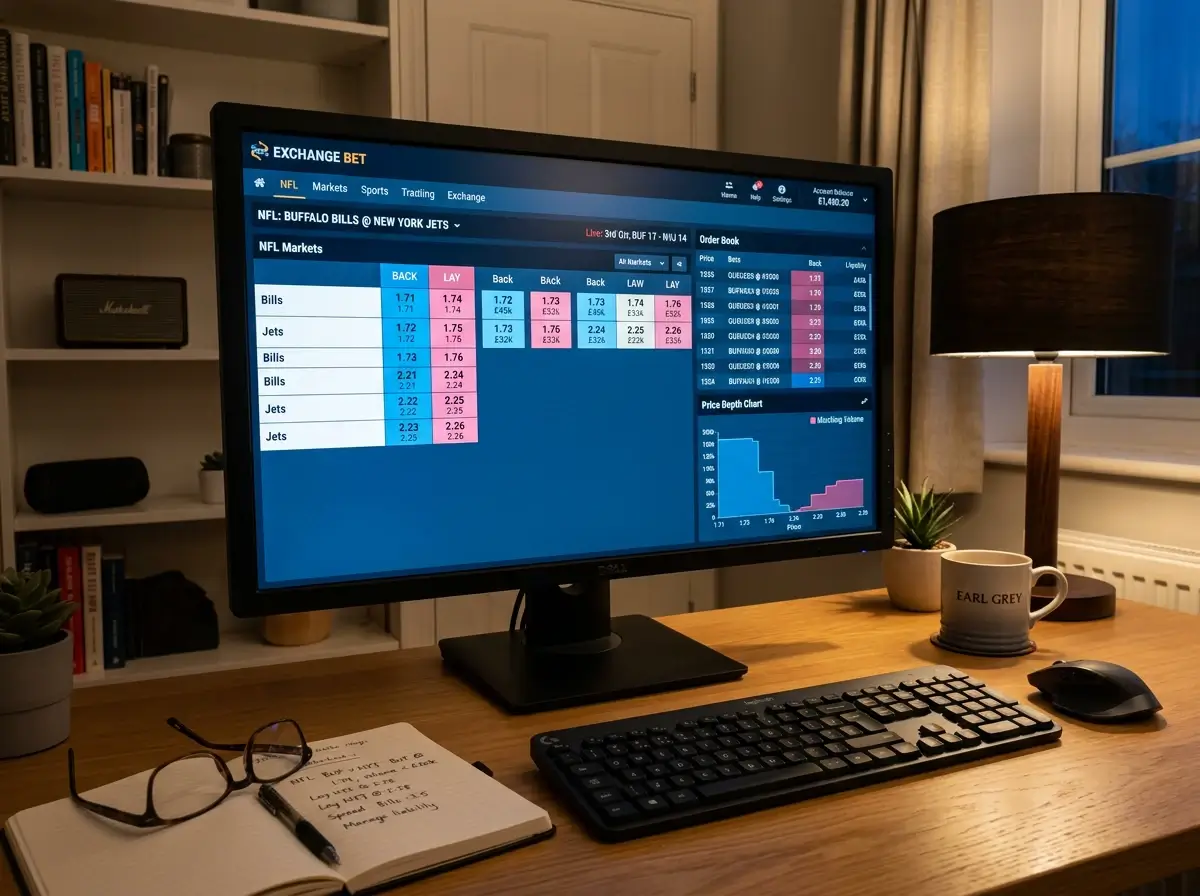
I opened my first Betfair Exchange account in 2018 specifically to trade an NFL playoff game. I had been using traditional sportsbooks for years and was tired of what I perceived as inflated margins on American football lines. The exchange promised better odds, the ability to lay outcomes I disagreed with, and the kind of peer-to-peer market that felt closer to financial trading than traditional gambling. What I actually got was a six-hour lesson in why NFL exchange betting in the UK is a completely different discipline from exchange betting on Premier League football.
A betting exchange strips out the bookmaker entirely. Instead of the sportsbook setting the odds and taking the opposite side of your bet, you trade directly with other punters. One person backs an outcome, another lays it, and the exchange takes a small commission on winning bets — typically 2-5%. The theoretical advantage is clear: no bookmaker margin means better prices. The practical reality for NFL markets is considerably more nuanced, and understanding those nuances determines whether the exchange adds genuine value to your American football betting or simply adds complexity without reward.
How NFL Exchange Betting Differs From Traditional Sportsbooks
The mechanics of an exchange are simple enough to explain but take time to internalise. When you “back” a team on an exchange, you are betting that the outcome happens — identical to placing a bet at a sportsbook. When you “lay” a team, you are betting against that outcome, effectively taking the bookmaker’s role. You set a price at which you are willing to lay, and if another exchange user matches your offer, the bet is struck.
The commission model replaces the traditional margin. On a sportsbook, the overround is built into every price — you never see it explicitly, but it is always there, typically 4-6% on NFL spread markets. On an exchange, you see the raw market price and pay a flat commission on net winnings. For a standard Betfair account, that commission starts at 2% and can be reduced through loyalty schemes. In theory, this should always produce better effective odds than a sportsbook. In practice, it depends entirely on whether the market has enough liquidity for you to get matched at the price you want.
Setting your own odds is the exchange’s most powerful and most misunderstood feature. At a sportsbook, you accept the offered price or walk away. On an exchange, you can request any price you like. If you think the Eagles should be 2.10 to beat the Cowboys but the current exchange price is 2.00, you place a back order at 2.10 and wait. If the market moves in your direction — perhaps because an injury is announced — your order gets matched at the superior price. If it does not move, you have lost nothing except the opportunity. This patience-based approach to price discovery does not exist at traditional bookmakers.
The sports betting share of UK online gambling is 56.64%, but not all of that flows through exchanges. The vast majority of UK sports bets are placed with traditional sportsbooks, and exchange volume is concentrated heavily on horse racing and Premier League football. NFL exchange markets exist, but they operate in a different liquidity environment entirely.
Liquidity Challenges for NFL Markets on UK Exchanges
This is where the exchange dream meets the NFL reality. Liquidity — the amount of money available to be matched on any given market — is the lifeblood of exchange betting. Without liquidity, your orders sit unmatched, the available prices are worse than a sportsbook, and the theoretical advantage evaporates.
The UK accounts for roughly 3% of global NFL search traffic, which gives a sense of the audience size relative to Premier League football. That proportion translates directly into exchange liquidity. A Premier League match between two top-six sides might have hundreds of thousands of pounds matched on the Betfair Exchange before kick-off. An NFL regular season game between mid-table teams might have a few thousand. The gap is enormous, and it constrains what you can realistically do on an exchange with American football.
The markets where NFL liquidity concentrates are predictable: the Super Bowl, conference championships, Monday and Thursday Night Football, and the main spread market for marquee Sunday games. Outside those windows, you are dealing with thin markets where getting a meaningful stake matched at a competitive price can be genuinely difficult. Player prop markets and exotic NFL bets are essentially non-existent on UK exchanges — if you want to back a specific quarterback’s yardage total, you need a sportsbook.
Timing matters too. NFL exchange markets tend to be most liquid in the 30 minutes before kick-off, when the majority of pre-game trading happens. If you place an order on Tuesday for a Sunday game, expect it to sit unmatched until Saturday at the earliest. This is not a criticism of the exchange model — it is simply the consequence of NFL being a niche sport in the UK relative to domestic football.
Trading NFL Games on an Exchange: Strategies for UK Users
Despite the liquidity constraints, there are specific strategies where the exchange format genuinely outperforms traditional sportsbooks for NFL betting. The key is knowing which situations favour the exchange and which do not.
Pre-game trading around injury news is the most consistent edge. NFL injury reports follow a mandated schedule — Wednesday, Thursday, Friday updates, with a final game-day designation. When a key player’s status shifts from doubtful to out, the spread moves. On a sportsbook, the line adjusts almost instantly. On the exchange, there is often a lag because the NFL-focused liquidity is thinner and slower to react. If you are monitoring injury reports as they drop and can act quickly on the exchange, you can secure prices that reflect the old information while the market catches up.
In-play trading on the exchange offers a unique advantage: the ability to green up. If you backed a team pre-game at 3.00 and they score the opening touchdown, their exchange price might drop to 2.20. You can lay them at 2.20 to lock in a guaranteed profit regardless of the final result, or let the position ride. This green-book strategy is impossible at a standard sportsbook — you can only cash out at the operator’s offered price, which always includes a margin against you. On the exchange, you set your own exit price.
Hedging futures is another area where the exchange shines. If you backed the Buffalo Bills at 12.0 to win the Super Bowl before the season and they reach the conference championship, their exchange price might have shortened to 3.50. You can lay the Bills at 3.50 to guarantee a profit — either through the lay payout if they lose, or through the original back winnings minus the lay liability if they win. This level of position management turns a binary bet into a tradeable asset.
NFL Exchange Betting: Quick Answers
Exchange betting on NFL is a powerful tool for specific situations, but it is not a wholesale replacement for sportsbook betting on American football. Use the exchange where its strengths align with NFL’s characteristics — injury-driven price moves, in-play green-ups, and futures hedging — and use sportsbooks where liquidity and market variety matter most. The combination of both gives you the widest possible edge.
Which UK betting exchanges offer NFL markets?
Betfair Exchange is the dominant platform for NFL exchange betting in the UK, with the deepest liquidity by a significant margin. Smarkets and Betdaq also offer NFL markets, though with thinner volumes. Market availability tends to be widest during the playoffs and Super Bowl, with regular season coverage focused on primetime games and the main spread and total markets.
Is NFL exchange betting more profitable than using a sportsbook?
It depends on the market and the timing. For high-liquidity events like the Super Bowl or Monday Night Football, the exchange often offers better effective odds due to lower commission compared to sportsbook margins. For regular season games, player props, and exotic markets, sportsbooks typically offer better availability and faster execution. Most profitable NFL bettors use both — the exchange for specific edge situations and sportsbooks for day-to-day wagering.
This material was created by the UK NFL Betting Analysis team.
Related posts

NFL Cryptocurrency Betting in the UK: Current Status and Regulatory Outlook

NFL Betting Mistakes That UK Punters Make — and How to Fix Them